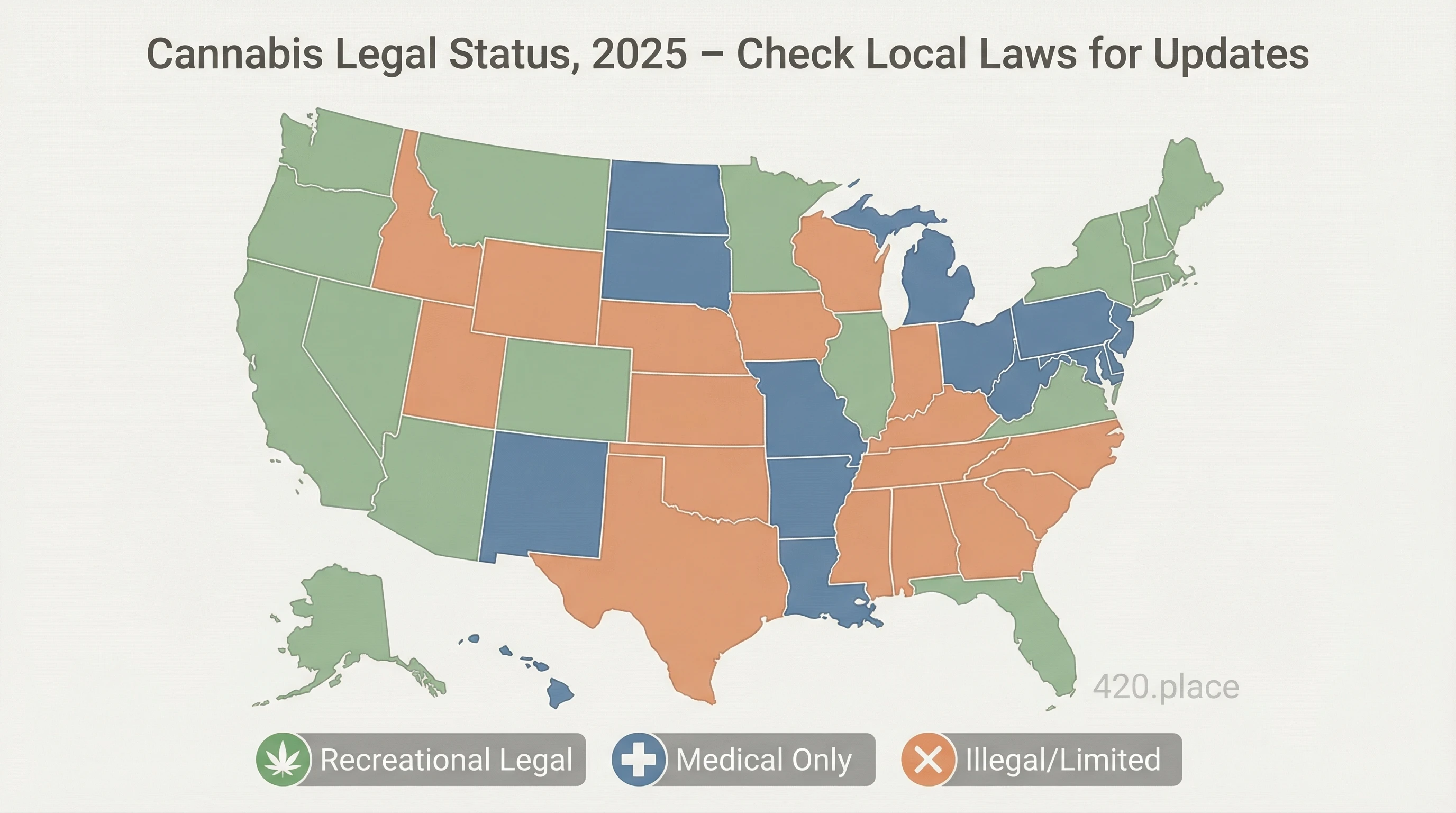
Texas Medical Marijuana Compassionate Use Guide 2026
Last updated: June 18, 2026
Note: Texas has one of the most restrictive medical cannabis programs in the United States. This guide reflects the latest changes from HB 46 and HB 1805, effective September 1, 2025. Always verify current requirements on official state websites.
Quick Summary
Texas does not issue physical medical marijuana cards. Instead, qualifying patients are entered into the Compassionate Use Registry of Texas (CURT), a confidential database managed by the Texas Department of Public Safety (DPS).
As of September 1, 2025, Texas expanded its Compassionate Use Program (TCUP) to include chronic pain and PTSD as qualifying conditions. The program now serves over 123,000 registered patients. Products are limited to low-THC cannabis (no more than 1 gram of THC per package) available in multiple forms including oils, tinctures, lozenges, patches, and inhalers.
Unlike most medical marijuana states, Texas patients receive a prescription (not a recommendation) from a physician registered with CURT. There is no application fee, no physical card to carry, and no patient-run application process. Your doctor enrolls you directly into the registry.
What Changed in 2025: HB 46 and HB 1805
Major Expansions Effective September 1, 2025
Chronic pain added as qualifying condition: House Bill 1805 added chronic pain to the list of qualifying conditions. This represents the single largest expansion of the TCUP program since its creation in 2015. Tens of thousands of Texans with chronic pain now qualify for medical cannabis.
PTSD now qualifies: Post-Traumatic Stress Disorder (PTSD) was added as a qualifying condition under HB 46. Previously, only veterans with PTSD qualified under a limited program. Now all Texas residents with PTSD can access medical cannabis regardless of military service.
Product form expansion: The program now allows additional delivery methods including transdermal patches and inhalers. Previously, only oils, tinctures, and lozenges were permitted.
THC limit change: The THC limit changed from a percentage concentration (previously capped at 1% THC by weight) to a total THC limit of 1 gram per package. This allows for more concentrated products as long as the total THC content does not exceed 1 gram.
What Has Not Changed
Texas still prohibits:
- Smokable cannabis flower
- Vaping products
- Edibles (gummies, chocolates, baked goods)
- High-THC concentrates like those available in other states
The program remains prescription-based. You cannot self-certify or use a general physician's recommendation to access dispensaries.
Qualifying Medical Conditions
As of September 1, 2025, Texas recognizes the following qualifying conditions for medical cannabis:
Current Qualifying Conditions
- Chronic pain (added September 2025)
- Post-Traumatic Stress Disorder (PTSD) (added September 2025)
- Epilepsy
- Seizure disorders
- Multiple sclerosis
- Spasticity
- Amyotrophic lateral sclerosis (ALS)
- Autism
- Terminal cancer
- Incurable neurodegenerative diseases
Understanding "Chronic Pain"
Texas law does not define "chronic pain" with strict criteria. Physicians have discretion to prescribe low-THC cannabis for patients experiencing persistent pain lasting longer than three months that interferes with daily activities.
Chronic pain includes conditions like:
- Arthritis and joint pain
- Back pain and disc problems
- Fibromyalgia
- Neuropathic (nerve) pain
- Migraine and chronic headaches
- Cancer-related pain
- Post-surgical pain
- Injury-related persistent pain
Your physician determines whether your pain qualifies based on medical history, treatment attempts, and pain severity.
How the Texas Compassionate Use Program Works
No Physical Card System
Texas does not issue medical marijuana cards. Instead, the state operates the Compassionate Use Registry of Texas (CURT), a secure database that tracks:
- Registered physicians authorized to prescribe low-THC cannabis
- Patients with active prescriptions
- Licensed dispensaries (called Compassionate Use Dispensing Organizations or CUDOs)
When your doctor writes a prescription for low-THC cannabis, they enter your information directly into CURT. Dispensaries verify your prescription through the database when you visit.
Prescription-Based (Not Recommendation)
Most medical marijuana states use a recommendation system. Doctors provide a written recommendation, and patients apply for a state card.
Texas uses a prescription system. Your physician writes an actual prescription for a specific low-THC cannabis product, just like they would for any controlled medication. The prescription includes:
- Dosing instructions
- Product form (oil, tincture, lozenge, patch, inhaler)
- Duration of treatment
- Refill authorization
This prescription-based approach gives physicians more control over your treatment but also means you cannot simply walk into a dispensary with a general medical cannabis recommendation.
Step-by-Step: Getting a Prescription
Step 1: Find a Registered Physician
Only physicians registered with the Compassionate Use Registry of Texas (CURT) can prescribe low-THC cannabis. Your regular doctor may not be registered.
The Texas Department of Public Safety maintains a list of registered physicians on its website. DPS maintains the current CURT physician registry; verify a physician in that registry before scheduling.
To find a registered physician:
- Visit the DPS TCUP physician directory: https://www.dps.texas.gov/sections/administration/compassionate-use-registry-texas
- Search by city or county
- Call practices to confirm they are accepting new patients
- Ask about telemedicine options (many CURT physicians offer video consultations)
Step 2: Schedule an Evaluation
Book an appointment with a CURT-registered physician. Many clinics specialize in medical cannabis evaluations, while others integrate cannabis treatment into general practice.
In-person evaluations: Traditional office visits allow face-to-face consultation. Bring medical records documenting your qualifying condition. Appointments typically last 15-30 minutes and cost $150-$300.
Telemedicine evaluations: Texas allows telemedicine consultations for TCUP prescriptions. Video visits offer convenience for patients in rural areas or with limited mobility. Costs are similar to in-person visits ($150-$300).
During the evaluation, the physician will:
- Review your medical history and current treatments
- Confirm your qualifying condition diagnosis
- Discuss low-THC cannabis as a treatment option
- Explain product forms, dosing, and expectations
- Answer your questions about the program
Step 3: Receive Your Prescription
If the physician determines low-THC cannabis is appropriate, they enter your prescription into the CURT database immediately. You do not receive a physical prescription document or card.
The physician provides:
- Confirmation that you are in the CURT database
- Product recommendations (oil, tincture, patch, etc.)
- Dosing instructions
- List of licensed dispensaries
- Information about refills and follow-up appointments
You can visit any licensed Texas dispensary as soon as your physician submits the prescription.
Step 4: Visit a Licensed Dispensary
Texas licenses Compassionate Use Dispensing Organizations (CUDOs) to dispense low-THC cannabis. Texas licenses a limited number of CUDOs; confirm the current list on the DPS Compassionate Use Program site.
At the dispensary:
- Bring a valid government-issued ID (driver's license, state ID, passport)
- Staff verify your prescription in the CURT database
- Pharmacists or trained staff help you select products based on your prescription
- You purchase products directly (no separate application or waiting period)
- Payment is typically cash or debit card (credit cards are rarely accepted due to federal banking restrictions)
Step 5: Follow-Up and Refills
Your prescription includes a duration (30, 60, or 90 days typically). Before it expires, schedule a follow-up appointment with your physician to:
- Discuss how the treatment is working
- Adjust dosing or product forms if needed
- Renew your prescription
Most physicians require follow-up appointments every 90 days to maintain an active prescription.
Available Product Forms
Texas law permits several low-THC cannabis product forms. Smokable flower and vaping cartridges remain illegal.
Permitted Product Types
Oils and tinctures: Liquid cannabis extracts administered sublingually (under the tongue) or mixed with food/beverages. Oils come in bottles with droppers for precise dosing. This is the most common product form in Texas.
Lozenges and tablets: Dissolvable tablets or lozenges that deliver cannabinoids through oral mucosa. Similar to sublingual absorption but in solid form.
Transdermal patches: Adhesive patches applied to skin that deliver cannabinoids slowly over several hours. Useful for all-day relief without repeated dosing.
Inhalers: Metered-dose inhalers similar to asthma inhalers. Deliver cannabinoid vapor without combustion. Faster onset than oils or patches.
THC Limits: 1 Gram Per Package
As of September 1, 2025, Texas law limits products to no more than 1 gram of total THC per package. This replaced the previous 1% THC concentration limit.
The new limit allows for more concentrated products. For example:
- A 30mL bottle could contain up to 1 gram of THC (approximately 33mg THC per mL)
- A package of lozenges could contain 1 gram of THC total (distributed across all lozenges)
- A transdermal patch could contain up to 1 gram of THC
This change provides more flexibility in dosing and product strength while maintaining strict state control over THC content.
What Is Still Prohibited
Texas does not permit:
- Smokable cannabis flower or pre-rolls
- Vaping cartridges or vape pens
- Edible gummies, chocolates, or baked goods
- High-THC concentrates (wax, shatter, live resin)
- Products exceeding 1 gram of THC per package
Costs and Affordability
Physician Evaluation Costs
- Initial evaluation: $150-$300
- Follow-up appointments: $100-$200
- Telemedicine visits: Usually priced the same as in-person visits
Some physicians offer package deals for initial evaluation plus several months of follow-up care.
Product Costs
Low-THC cannabis products in Texas are expensive compared to recreational states. Prices reflect limited competition (only 15 licensed dispensaries statewide) and high regulatory costs.
Typical prices:
- Tinctures/oils (30mL bottle): $100-$200
- Lozenges (30-count): $80-$150
- Transdermal patches (5-pack): $120-$180
- Inhalers: $150-$250
A month's supply typically costs $150-$300 depending on dosing and product type.
Insurance Coverage
Health insurance does not cover medical cannabis products because cannabis remains federally illegal. You pay out of pocket for both physician visits and dispensary purchases.
Some Health Savings Accounts (HSAs) and Flexible Spending Accounts (FSAs) may reimburse medical cannabis expenses, but policies vary. Check with your plan administrator.
Texas vs. Other Medical Marijuana States
Texas has one of the most restrictive medical cannabis programs in the United States. Understanding how Texas compares helps set realistic expectations.
How Texas Differs
| Feature | Texas | Most Other Medical States |
|---|---|---|
| Card System | No physical card | State-issued card required |
| Patient Application | No patient application | Patients apply to state program |
| Doctor Role | Prescription (like controlled substance) | Recommendation letter |
| THC Limit | 1 gram per package | No THC limits (or much higher) |
| Product Forms | Oils, tinctures, patches, inhalers, lozenges | All forms including flower and edibles |
| Smokable Flower | Prohibited | Permitted in most states |
| Qualifying Conditions | 10 conditions | 15-30+ conditions typically |
| Home Cultivation | Prohibited | Permitted in many states |
| Registry Privacy | Confidential state database | Varies (some public, most confidential) |
Why Texas Is Different
Texas approaches medical cannabis as a tightly controlled pharmaceutical program rather than a patient-centered medical marijuana program. The prescription model, product restrictions, and limited qualifying conditions reflect conservative state politics and law enforcement concerns.
Advocates continue pushing for program expansion. Recent additions of chronic pain and PTSD show progress, but Texas remains years behind states like California, Colorado, or Michigan in program breadth.
Patient Registry and Privacy
CURT Database
The Compassionate Use Registry of Texas (CURT) is managed by the Texas Department of Public Safety. It contains:
- Patient names and identifying information
- Qualifying condition diagnoses
- Active prescriptions and dosing information
- Physician and dispensary transaction records
Privacy Protections
Texas law protects CURT data as confidential medical information. The database is not accessible to:
- General law enforcement (without a court order)
- Employers
- Landlords
- The general public
Limited access is granted to:
- The patient's prescribing physician
- Licensed dispensaries verifying prescriptions
- DPS staff administering the program
- Law enforcement with court orders in specific criminal investigations
Your participation in TCUP does not appear on background checks or criminal records. However, federal background checks for certain jobs (firearms, security clearances, federal employment) may ask about drug use, including legal medical cannabis.
Employment and Legal Protections
Employment Rights
Texas does not protect medical cannabis patients from employment discrimination. Employers can:
- Refuse to hire applicants who test positive for THC
- Terminate employees for positive drug tests
- Enforce drug-free workplace policies that exclude medical cannabis
Even with a valid TCUP prescription, you have no legal protection against employer drug testing policies.
Driving and DUI
It is illegal to drive while impaired by any substance, including low-THC cannabis. Texas does not have a legal per-se THC limit for driving (unlike alcohol's 0.08% BAC limit).
If stopped by law enforcement:
- Officers can conduct field sobriety tests
- You can be arrested for DUI if officers believe you are impaired
- Blood or urine tests may be ordered
Having a TCUP prescription does not protect you from DUI charges. Avoid driving during peak effects and wait until you feel fully functional.
Federal Law
Cannabis remains illegal under federal law. TCUP registration does not protect you from federal prosecution (though federal authorities rarely target medical cannabis patients).
Federal implications include:
- Cannabis use (even medical) disqualifies you from purchasing firearms (ATF Form 4473)
- Federal jobs and security clearances may be denied
- Immigration applications can be affected
- Student financial aid may be impacted
Traveling with Low-THC Cannabis
Within Texas
You can travel anywhere in Texas with low-THC cannabis purchased from a licensed dispensary. Keep products in original packaging with labels showing:
- Dispensary name and license number
- THC content
- Product name and batch number
If stopped by law enforcement, explain you are a registered TCUP patient. Officers can verify your prescription through the CURT database.
Out of State
Do not travel across state lines with cannabis products, even to states with medical or recreational programs. Interstate cannabis transport is a federal crime.
Texas does not offer reciprocity with other states' medical marijuana programs. Out-of-state medical cannabis cards are not valid in Texas.
Frequently Asked Questions
Can I grow my own cannabis in Texas?
No. Home cultivation of cannabis remains illegal in Texas, even for medical patients.
Do I need a specific diagnosis to qualify for chronic pain?
No. Physicians have discretion to prescribe low-THC cannabis for chronic pain based on your medical history and pain severity. Specific diagnoses like arthritis or fibromyalgia are not required, though documentation of persistent pain helps.
Can I use my TCUP prescription in other states?
No. Texas does not participate in interstate medical marijuana reciprocity programs. Your prescription is valid only at Texas-licensed dispensaries.
What if I test positive for THC at work?
Texas law does not protect medical cannabis patients from employment drug testing. Employers can terminate employees for positive THC tests regardless of TCUP registration.
Are there dispensaries near me?
Texas dispensary access is tied to licensed CUDOs; confirm current operating locations through the official program before planning a pickup. Larger cities like Austin, Dallas, Houston, and San Antonio have multiple locations. Rural areas may require travel of 50+ miles to the nearest dispensary.
Check the Texas DPS website for an updated list of licensed Compassionate Use Dispensing Organizations.
How long does a prescription last?
Prescriptions typically last 30, 60, or 90 days depending on your physician's recommendation. Schedule follow-up appointments before your prescription expires to maintain access.
Keep Learning
- Getting started: 420.place Start Guide for Beginners 50+
- Product types: Cannabis Product Types Guide
- Dosing guidance: Beginner Cannabis Dosing Guide
- Safety: Cannabis Drug Interactions with Medications
- Other states: California Medical Marijuana Card Guide, Ohio Marijuana Card Guide
Official Texas Sources
- Texas Department of Public Safety Compassionate Use Program: https://www.dps.texas.gov/section/compassionate-use-program
- Compassionate Use Registry of Texas (CURT) Physician Directory: https://www.dps.texas.gov/sections/administration/compassionate-use-registry-texas
- Texas Health and Safety Code Chapter 169 (TCUP statute): https://statutes.capitol.texas.gov/Docs/HS/htm/HS.169.htm
- Texas Original (dispensary and patient resources): https://www.texasoriginal.com/
- Marijuana Policy Project Texas Updates: https://www.mpp.org/states/texas/
- Full text of HB 46 (2025 expansion): https://capitol.texas.gov/BillLookup/History.aspx?LegSess=89R&Bill=HB46