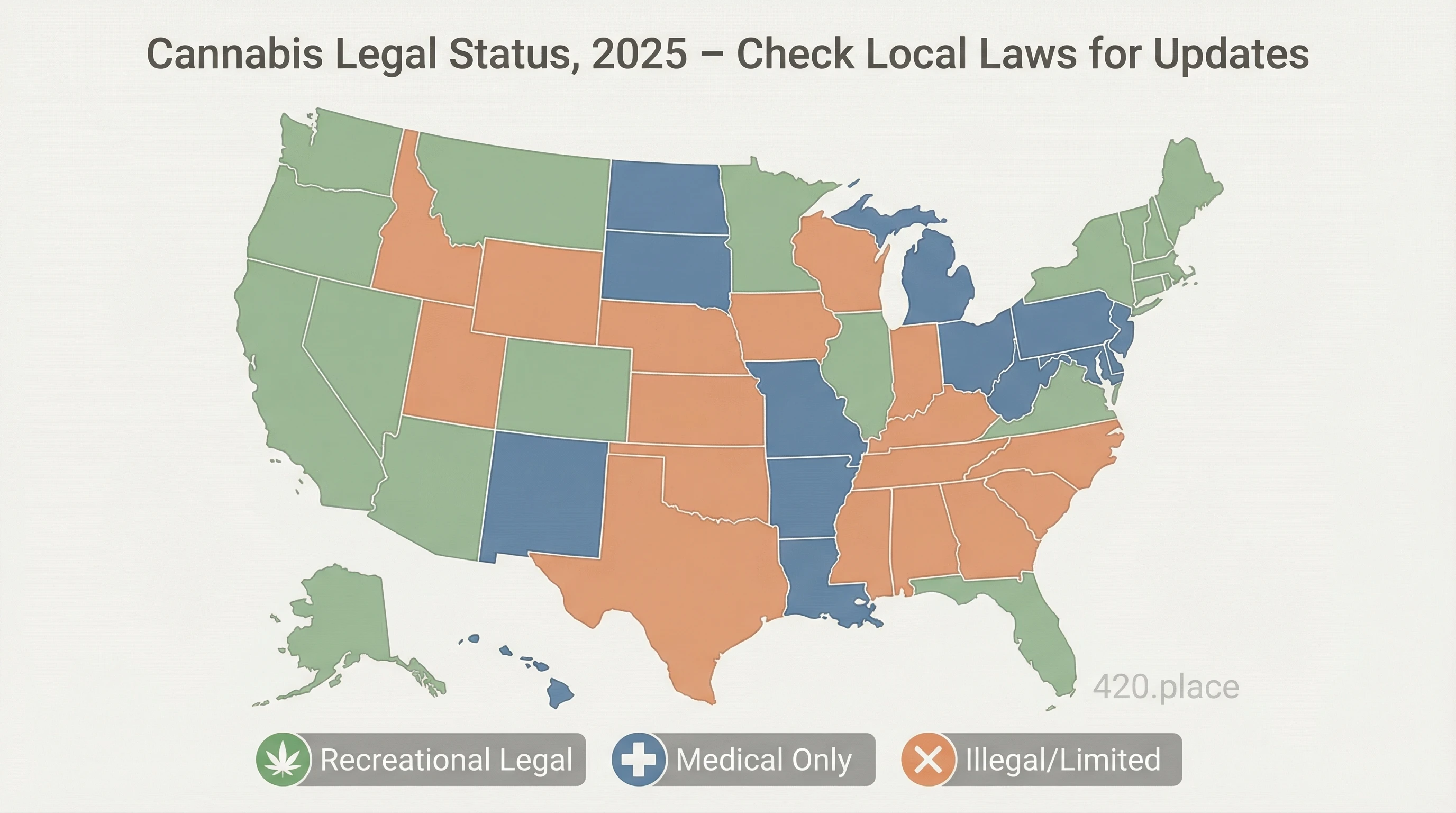
Illinois Cannabis Guide 2026: Medical vs Recreational
Last updated: June 18, 2026
Note: Illinois operates both medical and recreational cannabis programs. This guide explains both systems and helps you decide whether a medical card is worth obtaining.
Quick Summary
Illinois legalized recreational cannabis on January 1, 2020, making it the 11th state to do so. Adults 21 and older can purchase cannabis from licensed dispensaries without any card or registration. However, the medical marijuana program (established in 2014) continues to operate and offers significant benefits over recreational access.
Medical cardholders enjoy lower taxes, higher purchase limits, access to exclusive products, and additional legal protections. Illinois publishes current medical and adult-use program information through state cannabis and licensing portals.
The Illinois Department of Financial and Professional Regulation (IDFPR) oversees both programs. Recent state updates include seed-to-sale tracking and license-list changes; verify current IDFPR and Cannabis Regulation Oversight Office notices before relying on counts.
Recreational Cannabis in Illinois: The Basics
Who Can Purchase
Any adult 21 or older can purchase recreational cannabis from licensed Illinois dispensaries. You need only a valid government-issued ID:
- Illinois driver's license or state ID
- Out-of-state driver's license
- Passport
- Military ID
No registration, application, or medical condition required.
Purchase Limits for Recreational Users
Illinois residents (with IL ID) can purchase per transaction:
- 30 grams of dried flower (approximately 1 ounce)
- 5 grams of cannabis concentrate
- 500mg of THC in edibles
Non-residents (with out-of-state ID) can purchase half these amounts:
- 15 grams of dried flower
- 2.5 grams of concentrate
- 250mg of THC in edibles
These are per-transaction limits, not daily limits. You can make multiple purchases from different dispensaries in the same day, though dispensaries may track purchases to prevent excessive buying.
Recreational Taxes
Illinois imposes substantial taxes on recreational cannabis:
- 10% cannabis excise tax on purchases under 35% THC
- 20% cannabis excise tax on edibles, tinctures, and topicals
- 25% cannabis excise tax on concentrates and products over 35% THC
- Plus state sales tax (typically 6.25%)
- Plus local sales tax (varies by municipality, usually 1-4.75%)
Total taxes range from 25% to 40% depending on product type and location.
Example: A $50 product in Chicago might cost $70-$75 after all taxes.
Where Recreational Users Can Consume
Legal consumption locations:
- Private residences (with property owner permission)
- Private property not open to the public
- Cannabis consumption lounges (limited availability, licensed by municipalities)
Illegal consumption locations:
- Public places (parks, sidewalks, streets)
- Motor vehicles (driver or passenger)
- School property
- Any location where tobacco smoking is prohibited
- Within 1,000 feet of a school (if smoking)
Landlords and property owners can prohibit cannabis consumption on their property.
Medical Cannabis in Illinois: The Benefits
Illinois' medical cannabis program predates recreational legalization. Obtaining a medical card requires more effort but provides substantial advantages.
Benefits of Medical Card Over Recreational
Tax savings: Medical patients pay only standard sales tax (6.25% state + local). They are exempt from the 10-25% cannabis excise taxes. This saves $10-$25 on every $50 purchase.
Higher purchase limits: Medical patients can purchase up to a 90-day supply as determined by their physician:
- Typical limit: 2.5 ounces (70 grams) every 14 days
- Physicians can authorize higher amounts for specific conditions
Access to medical-only products: Some dispensaries carry high-potency or specialized products available only to medical patients (CBD-rich products, higher-dose edibles, specific tinctures).
Priority access: Medical patients may have dedicated hours, separate entrances, or priority during high-demand periods at some dispensaries.
Employment protections: Illinois law prohibits employers from discriminating against registered medical cannabis patients, with exceptions for safety-sensitive positions and federal requirements.
Lower age limit: Medical cards are available to patients of any age with qualifying conditions (minors require caregiver designation). Recreational access is 21+ only.
Home cultivation rights: Medical patients can grow up to 5 plants at home. Recreational users cannot grow cannabis at home in Illinois.
Interstate protections: Some states recognize Illinois medical marijuana cards for visiting patients.
Medical Card Costs vs. Tax Savings
Medical card costs:
- Physician certification: $150-$300
- State application fee: $50 per year ($100 for 2 years, $125 for 3 years)
- Total first year: $200-$350
Tax savings for regular users:
- If you spend $100/month on cannabis, you save approximately $25-$40/month in excise taxes
- Annual savings: $300-$480
- The medical card pays for itself within 1-2 months for regular users
For occasional users (under $50/month), the tax savings may not justify the card cost. For frequent or daily users, the medical card is a significant money-saver.
Qualifying Conditions for Medical Cannabis
Illinois recognizes approximately 55 qualifying conditions, including terminal illnesses and debilitating medical conditions.
Major Qualifying Conditions
- AIDS (Acquired Immune Deficiency Syndrome)
- Agitation of Alzheimer's disease
- Alzheimer's disease
- Anorexia
- Anxiety
- Arnold-Chiari malformation
- Arthritis (rheumatoid and osteoarthritis)
- Autism
- Autoimmune diseases
- Cachexia/wasting syndrome
- Cancer
- Causalgia (nerve pain)
- Chronic inflammatory demyelinating polyneuropathy
- Chronic pain
- Complex regional pain syndrome
- Crohn's disease
- Colitis
- Damage to nervous tissue of the spinal cord
- Degenerative disc disease
- Dystonia
- Ehlers-Danlos syndrome
- Epilepsy
- Fibromyalgia
- Fibrous dysplasia
- Glaucoma
- Hepatitis C
- HIV (Human Immunodeficiency Virus)
- Huntington's disease
- Hydrocephalus
- Hydromyelia
- Interstitial cystitis
- Irritable bowel syndrome
- Lupus
- Migraine headaches
- Multiple sclerosis
- Muscular dystrophy
- Myasthenia gravis
- Myoclonus
- Nail-patella syndrome
- Neuro-Behcet's autoimmune disease
- Neuropathy
- Obstructive sleep apnea
- Opioid use disorder (alternative treatment)
- Osteoarthritis
- Parkinson's disease
- Post-Traumatic Stress Disorder (PTSD)
- Reflex sympathetic dystrophy
- Residual limb pain
- Rheumatoid arthritis
- Seizures (including epilepsy)
- Severe fibromyalgia
- Sickle cell anemia
- Spinal cord disease or injury
- Spinocerebellar ataxia
- Superior canal dehiscence syndrome
- Syringomyelia
- Tarlov cysts
- Terminal illness with a diagnosis of less than 6 months to live
- Tourette syndrome
- Traumatic brain injury
- Ulcerative colitis
Chronic Pain and Anxiety
Two of the broadest qualifying categories:
Chronic pain: Persistent pain lasting longer than 12 weeks that interferes with daily activities. Physicians have discretion to certify patients with documented chronic pain from any cause.
Anxiety: Generalized anxiety disorder, panic disorder, social anxiety, or other anxiety conditions diagnosed by a healthcare provider.
Step-by-Step Medical Card Application
Step 1: Obtain a Physician Certification
Only Illinois-licensed physicians, physician assistants, or advanced practice nurses can certify patients for medical cannabis. Your regular doctor may offer certifications, or you can visit a specialized cannabis clinic.
Finding a certifying provider:
- Ask your primary care physician if they are registered
- Search for cannabis evaluation clinics in your area
- Many providers offer telemedicine consultations
What to expect:
- Bring medical records documenting your qualifying condition
- Appointment typically lasts 15-30 minutes
- Provider reviews your condition, medications, and treatment history
- Discusses cannabis as a treatment option
- Issues certification if appropriate
Costs: $150-$300 for initial certification (telemedicine and in-person typically same price)
Certification details: The provider issues a written certification stating:
- Your qualifying condition
- Recommendation for medical cannabis treatment
- Provider's signature and medical license number
- Date of certification
Step 2: Register with the Illinois Medical Cannabis Patient Registry
Visit the Illinois Department of Public Health (IDPH) Medical Cannabis Patient Registry at https://medicalcannabis.illinois.gov/.
Create an account:
- Provide personal information (name, address, date of birth)
- Enter Illinois driver's license or state ID number
- Create username and password
Complete application:
- Upload physician certification (PDF or image)
- Upload proof of Illinois residency (utility bill, lease, bank statement dated within 90 days)
- Upload government-issued photo ID
- Upload a passport-style photo of yourself
Pay application fee:
- $50 for 1-year card
- $100 for 2-year card
- $125 for 3-year card
- Payment by credit card, debit card, or electronic check
Veterans, SNAP, and SSI recipients: Reduced fees apply. Upload proof of veteran status, SNAP enrollment, or SSI benefits for discounted rates.
Step 3: Wait for Approval and Receive Your Card
The Illinois Department of Public Health reviews applications within 30 days (usually faster, often 7-14 days).
Once approved:
- You receive an email notification
- Log into your patient portal to download your digital medical cannabis card
- Print a physical copy or show digital version on smartphone at dispensaries
Card includes:
- Your name and photo
- Patient ID number
- Expiration date
- QR code for dispensary verification
Required Documents
For physician certification:
- Medical records documenting qualifying condition
- Government-issued ID
- List of current medications
For state application:
- Physician certification letter (dated within 90 days)
- Proof of Illinois residency (utility bill, lease, bank statement within 90 days)
- Illinois driver's license or state ID
- Digital passport-style photo
- Payment method
Medical Cannabis Purchase Limits
Medical patients can purchase:
- 2.5 ounces (70 grams) of cannabis flower every 14 days (standard limit)
- Equivalent amounts of concentrates, edibles, and other products
Equivalency calculations:
- 1 gram of concentrate = 5 grams of flower
- 1 dose of edible (typically 10mg THC) = 1 gram of flower
Physicians can authorize higher limits for patients with severe conditions. Dispensaries track purchases electronically to ensure compliance with limits.
Home Cultivation for Medical Patients
Medical cannabis patients can grow up to 5 plants at home for personal use.
Cultivation Requirements
- Maximum 5 plants per patient (at any stage of growth)
- Cultivation must occur in a locked, enclosed area not visible from public view
- Must be at private residence (renters need landlord permission)
- Local ordinances may impose additional restrictions (check your city/county rules)
Home Cultivation Tips
- Ensure proper ventilation and odor control
- Use locked grow tent or dedicated room
- Keep detailed records (some municipalities require cultivation registration)
- Do not sell or distribute homegrown cannabis (personal use only)
Recreational users cannot grow cannabis at home in Illinois. Home cultivation is a medical-only privilege.
Illinois Dispensary Rules and Regulations
Dispensary Hours
Illinois law permits dispensaries to operate from 6:00 AM to 10:00 PM daily. Individual dispensaries set their own hours within this window.
Most dispensaries operate:
- 9:00 AM to 9:00 PM weekdays
- 10:00 AM to 10:00 PM weekends
Some dispensaries open as early as 6:00 AM or stay open until 10:00 PM to accommodate working patients.
Finding Dispensaries
Illinois license counts change as regulators update license lists. Confirm the current dispensary and license records through the state portal before travel or purchase planning.
To find dispensaries near you:
- Visit the IDFPR dispensary map: https://www.idfpr.com/profs/adultusecan.asp
- Search by city, county, or zip code
- Check dispensary websites for menus, hours, and specials
What to Bring to Dispensaries
Recreational customers need:
- Government-issued photo ID (proving age 21+)
Medical patients need:
- Medical cannabis card (digital or printed)
- Government-issued photo ID
First-time visitors often complete intake forms and may receive consultations from budtenders about product selection.
Payment Methods
Most Illinois dispensaries accept:
- Cash (ATMs usually available on-site)
- Debit cards (with PIN, processed as ATM withdrawal)
Few dispensaries accept credit cards due to federal banking restrictions on cannabis businesses.
Metrc Seed-to-Sale Tracking (New in July 2025)
Illinois implemented the Metrc tracking system in July 2025. Metrc is a seed-to-sale software that tracks cannabis from cultivation through processing, testing, distribution, and sale.
What Metrc Means for Consumers
Product safety: Every product is tracked through the supply chain, ensuring quality control and preventing contaminated products from reaching consumers.
Lab testing verification: Metrc integrates lab test results, allowing dispensaries and regulators to verify potency and purity.
Inventory accuracy: Real-time tracking prevents diversion and ensures dispensaries maintain proper stock.
Regulatory compliance: Metrc helps Illinois enforce regulations, ensuring all cannabis is grown, processed, and sold legally.
For consumers, Metrc operates in the background. You won't interact with the system directly, but it enhances product safety and supply chain transparency.
IDFPR Licensing and Oversight
The Illinois Department of Financial and Professional Regulation (IDFPR) oversees all cannabis business licenses, including:
- Dispensaries (adult-use and medical)
- Cultivation centers (growing facilities)
- Processing facilities (manufacturers of edibles, concentrates, and other products)
- Transporters (licensed cannabis transportation companies)
93 New Dispensaries in FY2025
Illinois issued 93 new adult-use dispensary licenses in fiscal year 2025, focusing on:
- Social equity applicants (prioritizing communities disproportionately impacted by cannabis prohibition)
- Geographic diversity (expanding access in rural and underserved areas)
- Minority-owned businesses
This expansion significantly improves access statewide. Previously underserved counties now have local dispensaries, reducing travel requirements for patients and consumers.
Traveling with Cannabis in Illinois
Within Illinois
Legal:
- Transporting cannabis in sealed, original packaging
- Keeping cannabis in trunk or locked container (if in vehicle)
- Possessing amounts within legal limits
Illegal:
- Open containers in vehicles (driver or passenger)
- Consuming cannabis while driving
- Possessing cannabis on school property
- Public consumption
Out of State
Federal law prohibits crossing state lines with cannabis, even to other legal states. Do not:
- Fly with cannabis (even within Illinois or to legal states)
- Drive across state borders with cannabis
- Mail cannabis through USPS or private carriers
Illinois medical cannabis cards are not recognized in most other states. Check specific state reciprocity agreements before traveling.
Medical vs. Recreational: Side-by-Side Comparison
| Feature | Medical Card | Recreational (21+) |
|---|---|---|
| Minimum Age | Any age (minors need caregiver) | 21+ only |
| Application Required | Yes (physician + state registry) | No |
| Cost | ~$200-$350/year | $0 |
| Taxes | 6.25% sales tax only | 25-40% total taxes (excise + sales) |
| Purchase Limits | 2.5 oz every 14 days (standard) | 30g per transaction (IL residents) / 15g (non-residents) |
| Home Cultivation | 5 plants allowed | Prohibited |
| Product Access | Medical-only products available | Standard adult-use products |
| Employment Protections | Yes (with exceptions) | No |
| Dispensary Hours | Same (6am-10pm) | Same (6am-10pm) |
| Interstate Recognition | Limited reciprocity in some states | None |
Employment Protections for Medical Patients
Illinois law protects registered medical cannabis patients from employment discrimination:
Protected:
- Employers cannot refuse to hire or terminate employees solely for being medical cannabis patients
- Off-duty medical cannabis use is protected
- Employers must accommodate medical use (similar to prescription medications)
Not protected:
- Employees impaired by cannabis at work
- Safety-sensitive positions (commercial drivers, heavy equipment operators, positions involving public safety)
- Positions subject to federal drug-free workplace requirements (DOT-regulated jobs, federal contractors)
- Jobs requiring federal background checks or security clearances
Drug testing: Employers can conduct drug testing, but positive THC results alone cannot be the sole basis for termination of medical cardholders. Employers must demonstrate impairment or safety concerns.
Frequently Asked Questions
Should I get a medical card if recreational is legal?
If you use cannabis regularly (more than once a week), yes. Tax savings alone justify the cost within 1-2 months. Medical cards also provide higher limits, home cultivation rights, and employment protections.
Can I grow cannabis at home?
Only if you have a medical cannabis card. Recreational users cannot grow cannabis at home in Illinois.
What's the difference between medical and recreational dispensaries?
Many dispensaries serve both medical and recreational customers. Medical patients may have dedicated entrances, priority hours, or access to medical-only products.
Can non-residents purchase recreational cannabis?
Yes. Non-residents with valid ID can purchase half the amount of Illinois residents (15g flower, 2.5g concentrate, 250mg edibles per transaction).
How long does the medical card application take?
Typically 7-14 days after submitting your complete application. The IDPH has up to 30 days to review applications.
Can I use cannabis and still own a firearm?
Federal law prohibits cannabis users (including medical patients) from purchasing or possessing firearms. Question 21e on ATF Form 4473 asks about unlawful controlled substance use. Cannabis remains federally illegal, so technically any cannabis use (medical or recreational) disqualifies you from firearm ownership under federal law.
Do Illinois medical cards work in other states?
Limited reciprocity exists. Some states recognize Illinois cards for visiting patients. Check specific state laws before traveling.
Keep Learning
- Getting started: 420.place Start Guide for Beginners 50+
- Product types: Cannabis Product Types Guide
- Dosing guidance: Beginner Cannabis Dosing Guide
- Safety: Cannabis Drug Interactions with Medications
- Other states: Ohio Marijuana Card Guide, California Medical Marijuana Card Guide
Official Illinois Sources
- Illinois Department of Financial and Professional Regulation (IDFPR): https://www.idfpr.com/profs/adultusecan.asp
- Illinois Department of Public Health Medical Cannabis Program: https://dph.illinois.gov/topics-services/prevention-wellness/medical-cannabis.html
- Medical Cannabis Patient Registry: https://medicalcannabis.illinois.gov/
- Find Licensed Dispensaries: https://www.idfpr.com/profs/adultusecan.asp
- Cannabis Regulation and Tax Act (recreational law): https://www.ilga.gov/legislation/publicacts/101/PDF/101-0027.pdf
- Compassionate Use of Medical Cannabis Program Act: https://www.ilga.gov/legislation/ilcs/ilcs3.asp?ActID=3503