How to Reduce Cannabis Smell Indoors
Cannabis odor can be noticeable long after smoke is produced, but there is no universal removal time and no single product that guarantees complete odor removal. A practical plan starts by reducing the source, then uses ventilation, cleaning, and filtration as separate tools.
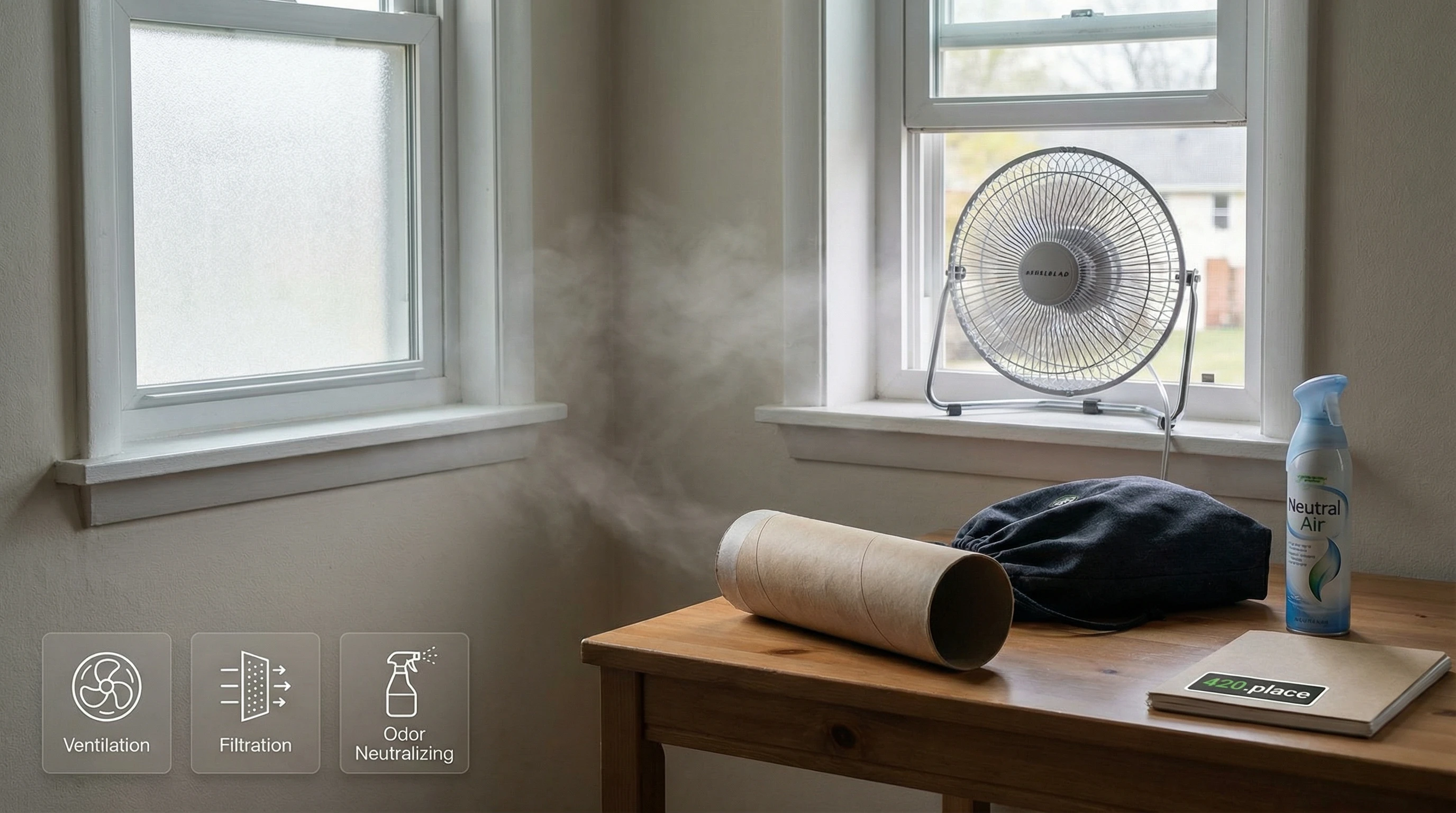
This guide is about indoor air and odor management. It is not a way to hide unsafe behavior or bypass a smoke-free building rule. The CDC notes that secondhand cannabis smoke contains many of the same toxic and cancer-causing chemicals found in tobacco smoke. Protecting other people from smoke matters more than masking a smell.
Start with source control
EPA indoor-air guidance treats source control as a primary strategy. In plain language, the most effective way to reduce new cannabis smoke and odor indoors is to stop producing it in the room. Follow lease, workplace, hotel, and local smoke-free rules. Keep smoking away from children, visitors, pets, and people with asthma or other respiratory concerns.
If cannabis is stored legally, keep it closed in its original child-resistant packaging or another secure, airtight container. Storage can reduce odor from the product itself, but it does not make smoking indoors safe and it does not remove pollutants already in the air.
Ventilate when outdoor air is suitable
For indoor air concerns, source control and ventilation with clean outdoor air are the most effective primary steps; filtration is a supplement. When weather, outdoor smoke, pollen, security, and building rules permit, open windows or doors and use a fan that exhausts air outdoors. A kitchen or bathroom exhaust fan may help only if it actually vents outdoors.
Ventilation dilutes indoor pollutants; it does not prove that every gas or particle has been removed. Do not move smoky air into a shared hallway, another apartment, or an occupied room. If outdoor air quality is poor, keep windows closed and follow local air-quality guidance.
Use filtration for the job it can do
Portable air cleaners and HVAC filters can reduce airborne particles when they are correctly sized, operated, and maintained. For particles, the EPA guide to home air cleaners recommends looking at the clean air delivery rate, or CADR, and choosing a unit sized for the room. Higher fan speeds and longer run times generally filter more air, although noise and energy use may increase.
Odors and gases are different from particles. Filters containing activated carbon or another gas-removal medium may reduce some gases, but performance varies with the amount of material, airflow, pollutant, and maintenance. No air cleaner removes every pollutant, and gas or odor performance is not covered by a widely used rating system. Treat marketing claims such as "instant," "complete," or "permanent" removal cautiously.
Replace filters according to the manufacturer's instructions. A loaded filter may work poorly. Air cleaning is a supplement to source control and ventilation, not permission to expose other people to smoke.
Clean residue without creating another hazard
Once the air has cleared, wash fabrics and wipe hard surfaces according to the item and cleaning-product labels. Launder washable clothing, bedding, or curtains using the care instructions. Vacuum upholstery or carpets with equipment suitable for the material. For painted walls, furniture, vehicle interiors, or electronics, use only products approved for that surface.
Increase ventilation while cleaning. Never mix cleaning products, and do not improvise chemical recipes. Bleach mixed with ammonia, acids, or some other cleaners can release dangerous gases. Spot-test a cleaner in an inconspicuous area before wider use.
Avoid ozone-generating shortcuts
Ozone generators should not be used in occupied spaces as an odor-control shortcut. EPA guidance on ozone generators says ozone at concentrations that meet public-health standards is generally ineffective at controlling indoor air pollution, and ozone can harm the lungs. Be wary of devices marketed with terms such as "activated oxygen," "super oxygen," or intentional ozone generation.
Technologies that claim to oxidize pollutants can also create byproducts. Before buying any air-cleaning device, check whether it intentionally emits ozone and look for independent performance information rather than testimonials alone.
A realistic checklist
- Stop the indoor source and respect smoke-free rules.
- Move children, pets, and non-users away from smoke exposure.
- Ventilate to clean outdoor air when conditions and building rules allow.
- Run a correctly sized particle filter if one is available.
- Use substantial activated-carbon media only as a possible aid for gases and odor, not a guarantee.
- Clean washable fabrics and compatible surfaces according to their labels.
- Avoid ozone generators and unverified chemical shortcuts.
- Recheck the room rather than relying on a fixed "odor gone" timer.
What this guide cannot promise
Odor persistence depends on the source, room size, ventilation, materials, and other conditions. A smell test cannot establish that indoor air is free of harmful pollutants. If smoke exposure causes breathing difficulty, chest symptoms, or another urgent concern, leave the exposure area and seek appropriate medical help.
For more context, see Responsible Use and How We Fact-Check.